First-rate 1970s TV mystery noir thriller starring Ian McShane.
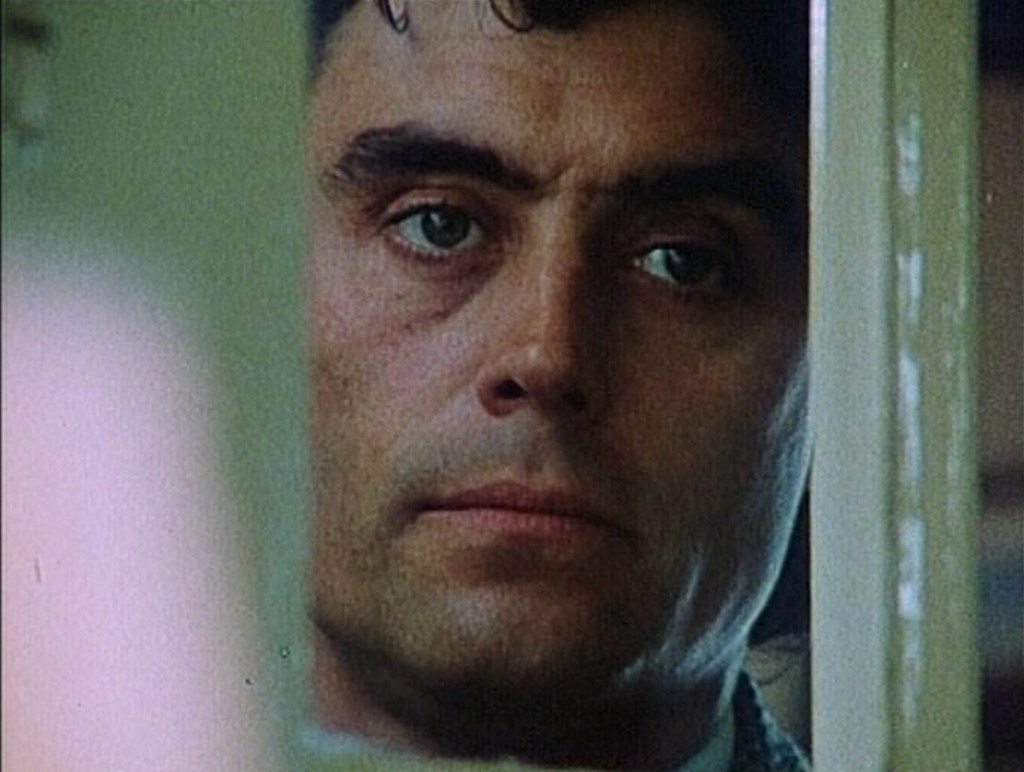
When we think of film noir, the images that typically come to mind are steeped in American settings: dimly lit bars, dilapidated tenement buildings, shadowy alleyways, bustling shipping docks, and smoke-filled train stations. Other evocative locations might include small towns shrouded in secrets, lonely highways, truck stops, and cheap motels. Yet noir traditions exist outside America, each with distinct locales and cultural nuances. French noir, for instance, comes with its own unique aesthetic sensibility, prioritizing psychological depth and atmosphere. Indeed, France can legitimately claim to have pioneered cinematic noir with the poetic realist films of Jean Renoir (La Bête humaine, 1938) and Marcel Carné (Le Quai des Brumes, 1938). In England, noir films such as It Always Rains on Sunday (1947), Brighton Rock (1948), and Night and the City (1950) created their own distinct milieu, rooted in urban settings that conveyed a gritty, homegrown realism. The English countryside, on the other hand, has long been associated with the genteel puzzles of Golden Age murder mysteries by writers like Agatha Christie, Margery Allingham, and Dorothy L. Sayers, seemingly at odds with noir’s darker, more fatalistic tones. Yet in art, as in life, there are always exceptions, and High Tide, a television drama serial first broadcast in 1979 as part of Thames Television’s Armchair Theatre and now regularly screened on Talking Pictures TV as a two-hour film, is a striking example. It melds the noir sensibility with the atmospheric tension of the British coastline, bridging these two seemingly disparate traditions with remarkable success.
The story begins with a car on a quiet country road. Behind the wheel is Peter Curtis (Ian McShane), just released from prison after a five-year stretch, and now on his way to the coast to buy a boat and what he hopes will be the start of a new quiet life. He chooses to drive at night, sleeping by day at out-of-the-way hotels to reclaim the “mental privacy” he lost during his incarceration. Yet, no matter how hard he might desire it, the past won’t leave him alone. Firstly, there are the memories that invade his thoughts of the traumatic incident that landed him in jail: his dog run over, his attack on the driver who caused it – a man named Maxwell (Malcolm Terris) – and Maxwell’s death from a heart attack. As if that were not enough, a mysterious car appears to be following him. Needing rest, he checks into a country hotel for a restorative sleep. After awakening, he takes tea in the hotel garden, and here at last he meets the driver of the car that has been following him. The man introduces himself as Matthews (Terence Rigby). Matthews knows all about the episode that led to Curtis’s incarceration. Did Maxwell say anything, he wants to know, in the final moments before he died? Try as he might, however, Curtis cannot remember – not yet anyway. The night of the following day, after a sleepless night, the picture starts to become clearer. “High tide…,” croaked the dying man. This leads to a somewhat improbable clue involving Curtis’s previous car number plate and a chart of tide tables. But more importantly, it engenders in Curtis a newfound sense of purpose to solve the mystery for himself.
Continuing his course south, Curtis picks up a young woman named Celia (Wendy Morgan) hitchhiking in the rain. They travel together to the coast where Curtis finally buys his sailboat, incongruously named Madge. A close friendship develops between Curtis and Celia – here at last it seems is somebody he can trust. But is she too good to be true? Curtis’s suspicions are raised when he sees her talking to somebody in a car, and then lying about it afterward. Somehow, in some way, it seems she is mixed up in the business at hand, but to what end is not clear, and becomes no clearer after she leaves under cover of darkness without a word of explanation. Upping anchor, Curtis sets sail for Yealmouth, “a place of dangerous sands and few visitors.”
The British coastline and its relentless sea have a raw, elemental quality that, when used as a backdrop, amplifies the scope and scale of any narrative. High Tide’s creators make full use of these locations, harnessing their atmospheric power to add visual dynamism and a sense of isolation, integral to the noir elements of the story. The bleak, unforgiving seascape mirrors the moral ambiguity and tension that defines the show, much like in the works of P.M. Hubbard whose novel inspired the series. Curtis, who feels adrift on land, gains a sense of purpose at sea, where he can escape the constraints of society and take control of his fate. Yet, as in classic noir, he is drawn back into the murky world he tried to leave behind, where personal choices and darker forces collide, propelling him toward inevitable conflict.
Dropping anchor in Yealmouth harbour, and convening to the local pub, Curtis is befriended by Cyril (John Bird), a friendly, if eccentric, naval history novelist. Cyril invites him to dinner that night at the remote house “on the point” he shares with his wife Helen (Kika Markham). On meeting Helen, Curtis is immediately smitten. He finds himself drawn not only to Helen’s quiet intelligence but also to some unspoken sadness that seems to simmer beneath her reserved demeanour. Dinner unfolds in the glow of candlelight, the conversation ranging from literature to the turbulent waters that surround the coast. Cyril, cheerful and oblivious, dominates the talk, while Curtis and Helen exchange knowing glances, almost as if communicating in their own language. By the time dessert is served, Curtis is entranced.
The next day, Curtis rows his dinghy to locate the precise spot where high tide peaked at 9:52 AM on the day of Maxwell’s death—a time intricately linked to the enigmatic clue of his old car’s number plate. Navigating in his small boat through “a landscape without scale or limit,” he spies a desolate old house that matches the coordinates. It was to here, he feels certain, that Maxwell must have been heading on that day. Curtis secures his dinghy and steps ashore. The place feels frozen in time, as though waiting for someone – or something – to break the silence. Curtis wonders what could have drawn Maxwell here on that fateful day.
Considering the complexity of Peter Curtis’s character, High Tide’s makers could hardly have chosen a better actor than Ian McShane. Like many noir protagonists Curtis is a victim of circumstance – what happened to him could happen to anybody. Who can really blame him, after all, for losing his temper after the death of his dog? Nor, indeed, for wanting to solve the mystery that has had such a calamitous impact on his own life? Yet, he seems to court danger, more detective hero than innocent dupe, and McShane, with his laconic delivery and calculating gaze carries it off perfectly.
High Tide also features a fine supporting cast. Terence Rigby embodies the noir heavy with his portrayal of Matthews, a man whose relentless pursuit of a big score mirrors the genre’s fatalistic ambition. Rigby’s controlled menace, reminiscent of his work in Harold Pinter’s plays, permeates two pivotal scenes: the first, a seemingly innocuous meeting in a sunlit pub garden, and the second, a perilous confrontation in the estuary’s treacherous tidal waters. These moments bookend the narrative, serving as the Alpha and Omega of Curtis’s journey and underscoring noir’s cyclical tension between light and shadow.
Wendy Morgan’s Celia captures the archetype of the femme fatale, yet with an unexpected twist. Her jittery intensity keeps her true motives tantalizingly ambiguous—friend, foe, or something in between? From the moment she emerges from the rainy night, ditching her companion to align with Curtis, Celia’s role is steeped in uncertainty. However, her ultimate undoing stems from a vulnerability that sets her apart: unlike her more coldblooded counterparts, Celia’s better nature proves ill-suited to the cutthroat criminal underworld, sealing her tragic fate.
John Bird’s portrayal of Cyril, Helen’s alcoholic husband, channels the noir archetype of the doomed intellectual. A writer shackled by a loveless marriage, Cyril’s quirky affability masks a desperate inner turmoil. He clings to Curtis like a drowning man to driftwood, his flailing attempts to escape the tides of his own failures and regrets mirroring the genre’s exploration of flawed, self-destructive characters.
Kika Markham delivers a standout performance as Helen, embodying the enigmatic woman so central to noir storytelling. Best known for her work in François Truffaut’s Two English Girls (1971), Markham brings a quiet intensity to a character burdened by memory, loss, and unfulfilled longing. Helen’s fragility is tempered by resilience, her emotions simmering beneath the surface like the currents of the estuary itself. Markham’s nuanced portrayal leaves Helen shrouded in mystery yet deeply human, embodying the noir tradition of characters caught between shadows and light, haunted by their pasts but striving for redemption.
Curtis and Helen’s swift descent into a love affair adds a layer of intensity and intrigue to the story, as Curtis becomes enamoured with and perplexed by Helen’s enigmatic presence. Their romance is charged yet laden with unspoken tensions, drawing Curtis deeper into Helen’s world and the secrets she guards. As they spend time together, Curtis senses there is more beneath Helen’s surface—a mysterious past she’s unwilling or unable to fully reveal. This sense of mystery fuels his fascination, and he becomes almost obsessive in his need to understand her, unknowingly entangling himself in her personal history. The affair blurs the line between passion and curiosity, pulling Curtis into Helen’s unresolved conflicts and emotional scars. Ultimately, as Helen’s secrets unfold, Curtis is forced to confront the truth behind her guardedness, illuminating her vulnerabilities and offering a final, poignant understanding of the woman he has come to care for so deeply. This revelation serves as the emotional crux of the film, intertwining the themes of love, loss, and the elusive nature of personal history.
Late in High Tide, a pivotal moment encapsulates why the drama rises above many of its contemporaries and firmly belongs within the noir tradition. Under the cloak of darkness on a desolate coastal point, Curtis and Helen embrace in a tightly framed shot as the camera circles them, evoking a direct homage to Alfred Hitchcock’s Notorious and its iconic close-up of Cary Grant and Ingrid Bergman. This scene exemplifies High Tide’s noir sensibility, weaving Hitchcockian influence into its narrative fabric. More than a visual tribute, director Colin Bucksey channels Hitchcock’s mastery of suspense and psychological nuance, crafting a pervasive atmosphere of tension and uncertainty.
Considering, in fact, how Hitchcockian High Tide is in its tone and subject matter, it’s hard not to speculate how he might have approached the material had he chosen to adapt it himself. Rather than ending his career with the underwhelming, campy Family Plot, High Tide could have served as the perfect swan song – a film that revisited his lifelong obsessions with murder, human vulnerability, and the ever-shifting dynamics of trust and betrayal. Hitchcock’s familiarity with “West Country noir” is evident in his adaptations of Daphne du Maurier’s Rebecca and Jamaica Inn, where windswept coastal settings became oppressive, almost sentient forces shaping the characters’ fates. With High Tide, he might have further enriched the psychological tension, employing his signature close-ups and subjective camera work to draw viewers deeper into the fractured psyches of Curtis and Helen. Hitchcock’s unparalleled command of pacing and suspense could have transformed High Tide into a masterpiece, blending the stark fatalism of noir with his characteristic psychological intricacy.
As it stands, Colin Bucksey proves more than up to the task of evoking Hitchcockian elements to elevate High Tide beyond the realm of ordinary TV drama. Through carefully crafted suspense, taut storytelling, and the evocative use of West Country coastal landscapes, Bucksey turns the rugged terrain into a noir battlefield, mirroring the characters’ internal conflicts and moral dilemmas. The flawed, richly drawn characters embody noir archetypes of desperation and ambiguity, their choices haunted by the shadows of past actions and uncertain futures. By blending these elements, High Tide emerges as a visually striking and emotionally resonant drama, embodying the timeless allure of the noir tradition and remaining a compelling, rewarding work decades after its release.

 Simon Hitchman
Finished now the view of high tide
fantastic movie !
LikeLiked by 1 person