Author’s Note:
Terence Stamp died on 17 August, and in the weeks since, I’ve found myself thinking not only of his films but of his presence — that poise, that voice, that quiet humour. Obituaries have covered the facts; what follows is a more personal reckoning, written in the afterglow of watching his younger and older selves meet on screen, and of remembering the books that once helped me imagine who I might become.
Introduction: Remembering Terence Stamp
“Memories are what you’ve got left. You hold on to them, and sometimes they hold on to you.” — The Limey (1999)
When I heard that Terence Stamp had died, I went to the shelf and took down his autobiography Stamp Album. I’d first read it in my early twenties, followed soon after by the companion volumes, Coming Attractions and Double Feature, at a time when I was trying to work out what sort of life might be possible. His voice — measured, modest, funny, slightly mystic — stayed with me. He wrote about the long silences and the sudden bursts of fame, the spiritual detours and the quicker vanishings, with a calm I hadn’t yet learned. Reading those three books, I began to feel I knew him a little: the London boy who had watched his own life turn stranger than any of his films.
There was also, for me, a tiny thread of kinship. My great-grandfather on my father’s side of the family had been a tugboat captain on the River Thames. Stamp’s father had been a tugboat stoker. It’s a small thing, but it makes him feel less remote, that a life so ordinary in origin could turn into something so rare.
What I admired most, then and now, was the stillness. Even when he was young, with the face that camera lenses practically fell in love with, there was an inwardness about him — a sense that he was half-listening to something deeper than dialogue. That quality never left him. It’s in the voice, the careful diction, the way he seems to measure the world before speaking. Perhaps that is why his performances have aged so well: they are not displays of energy but studies in composure.
If you follow that composure through three films — Poor Cow (1967), The Hit (1984), and The Limey (1999) — you can almost watch a life unfold. The three stand about fifteen years apart and, unintentionally, trace an actor’s autobiography: the luminous youth, the middle-aged exile, the ageing avenger. Seen together, they offer a shape to a career that otherwise defied one. Watching them again after his death felt like rereading those memoirs — not as an obituary but as a conversation that hadn’t quite ended.
Poor Cow (Ken Loach, 1967)
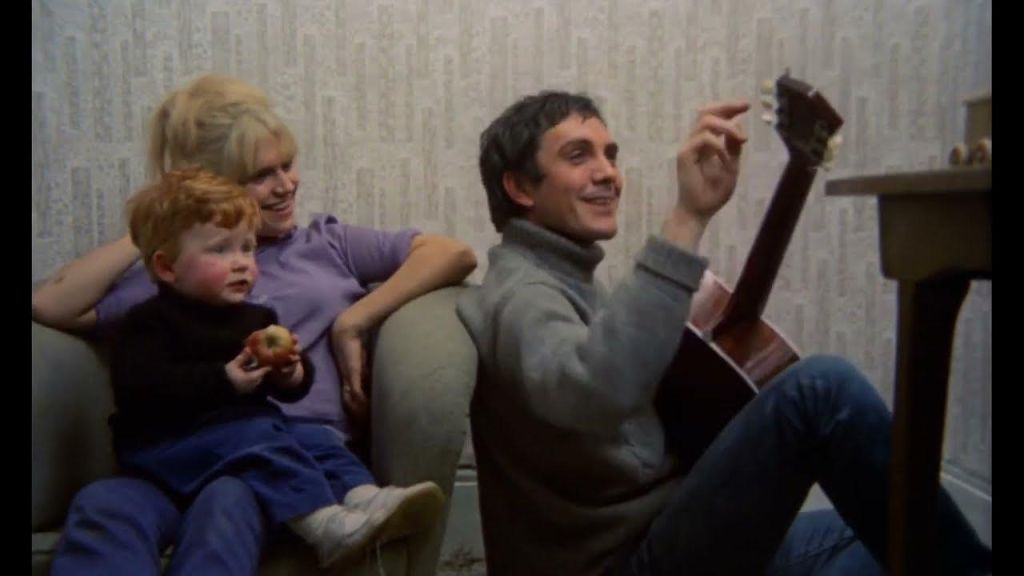
To look at Poor Cow again is to see what the camera saw first in Terence Stamp: a young man of startling beauty and self-possession who nevertheless seems slightly misplaced in the world around him. Ken Loach wanted realism — a grainy East End drama about a young woman raising a child while the men in her life drift in and out of prison. He cast Carol White as Joy and Stamp as Dave, the small-time thief who abandons her. In Loach’s documentary style, the actors were meant to blend into the background, but Stamp never quite could. The light finds him automatically; even in a cramped council flat, he seems sculpted from another material.
Dave isn’t much of a man. He’s charming, unreliable, one of those boys who never learned responsibility. But because it’s Stamp, the viewer — and Joy — can’t quite write him off. There’s that quick, sideways smile, the hint of thought behind the eyes. He is not ordinary; he doesn’t fit. Loach wanted social truth, but Stamp brings a different truth: the way a single extraordinary face can distort the reality around it.
I’ve often thought of Poor Cow as a portrait of potential, both the character’s and the actor’s. Dave wastes his chances, and Stamp, at that moment of his career, seemed in danger of doing the same. He was one of the key faces of 1960s cinema — Billy Budd, The Collector, Modesty Blaise, Far From the Madding Crowd, Teorema — a new kind of star who made working-class London look glamorous. Yet he always seemed slightly absent even in success, as if he knew the moment couldn’t last. Watching Poor Cow now, the resemblance between actor and character feels deliberate. Both are adored, both drift away.
Loach’s realism can’t quite absorb him. Stamp moves through the film like a premonition: too handsome, too graceful, almost too intelligent for the role. He’s meant to be another feckless man in Joy’s life, but his presence turns him into something larger — an emblem of what might have been. Loach catches him as if by accident, yet each shot feels aware of the camera’s awe.
When Stamp died, I thought of those scenes again, and of how that lightness of youth already carried melancholy. In 1967, he was at the centre of the new British cinema, dating Jean Shrimpton, friends with Michael Caine and Julie Christie, photographed in every magazine. Within a few years he was gone, living quietly in Italy and then in India, studying meditation, learning to be still. It is as if Dave’s disappearance from Joy’s life foreshadowed the actor’s withdrawal from ours.
There’s something in his face in Poor Cow — half-defiance, half-uncertainty — that makes you want to tell him to stay, to take better care of the gift he’s been given. But perhaps he knew better. The very things that made him unforgettable on film made it impossible for him to keep working in the new realism of the 1970s. He didn’t look like the rest of us. He never did.
The Hit (Stephen Frears, 1984)
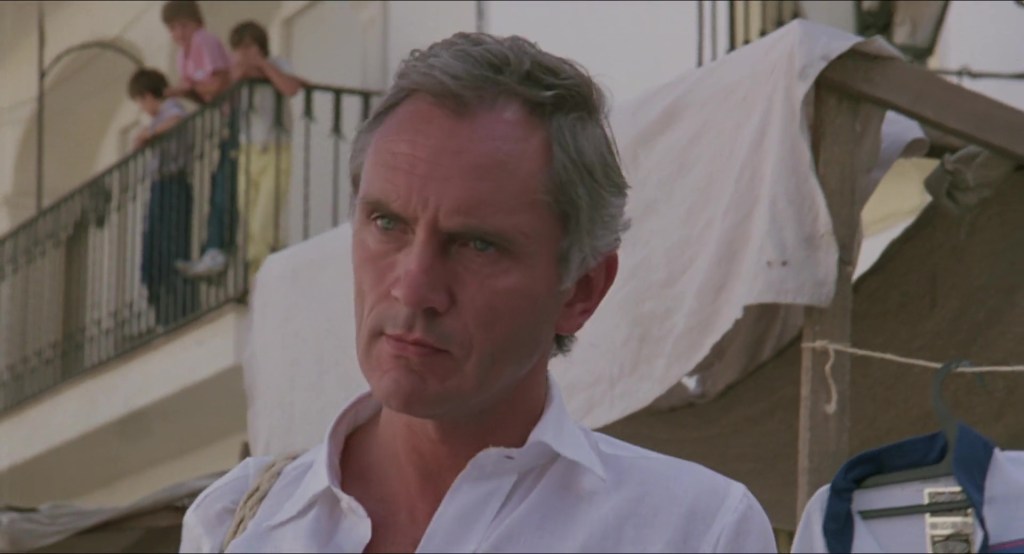
By the time he returned, seventeen years later, the transformation was astonishing. The fragile glamour of the sixties had weathered into something harder, more inward. The face was lined, the body leaner, the smile now closer to a question. Stephen Frears cast him as Willie Parker, a retired gangster who has betrayed his former associates and lives under police protection in Spain until two killers — John Hurt and Tim Roth — arrive to take him back to face execution.
The story sounds like a thriller, but Frears shoots it as something closer to a parable. Parker is calm, even cheerful. He thanks his captors, discusses philosophy, and quotes poetry. Hurt’s Braddock is unsettled by this composure; Roth’s young thug tries to provoke him, but Stamp’s stillness disarms them both. The performance is built almost entirely out of pauses and glances. He seems to have already lived through everything that frightens them.
It’s difficult not to read his own decade of disappearance into that calm. Stamp had gone to India, lived in ashrams, practiced meditation, stripped away the trappings of fame. When he came back, he seemed to have brought a piece of that quiet with him. The Hit is, among other things, a film about a man who has already died once and found the experience survivable. Watching it now, in the weeks after Stamp’s death, the serenity feels even more authentic — the work of someone who had made peace with impermanence.
Frears gives him the landscape he needs: Spain under a huge, unpitying sky, the road stretching ahead like time itself. Stamp sits in the back seat of the car, silver-haired, eyes half-closed against the glare, and you sense the film reshaping itself around him. Hurt gives a wonderfully tight, nervous performance, while Roth bristles with youthful energy; however, the power of the film lies in the spaces where Stamp simply listens. He has become a kind of moral vacuum, forcing everyone around him to reveal themselves.
I saw The Hit long before I read his autobiographies, but revisiting it later, I recognised the same tone: that measured, slightly ironic self-awareness. He could talk about death as calmly as about breakfast. There’s a line in Stamp Album where he describes fame as “an adventure that went on too long.” In The Hit, that understatement becomes a philosophy.
Compared to Poor Cow, the change is complete. The reckless young man has become the philosopher of his own mortality. What used to be radiance has turned into gravity. And yet there’s continuity too: the same gaze, the same reserve, the same sense of someone slightly apart from the ordinary world. If Poor Cow is about waste, The Hit is about reconciliation. It’s the middle movement in a life that has learned, at last, how to pause.
The Limey ( Steven Soderbergh, 1999)

Fifteen years later, Stamp appeared again, now in his sixties, in Steven Soderbergh’s The Limey — the last great act in this triptych. It’s the story of Wilson, a recently released Cockney criminal who travels to Los Angeles to find out who killed his daughter. The plot is simple, almost schematic, but Soderbergh builds something more intricate out of it: a film about memory and time, about what happens when the past walks into the present.
What made The Limey extraordinary, even on release, was Soderbergh’s decision to fold Poor Cow directly into it. When Wilson remembers his younger life, the film cuts to Loach’s footage from 1967. There is Stamp, impossibly young, smiling in that old London light. The trick is audacious but also moving. Wilson’s memories are literally the actor’s past; his youth is on film. In 1999, it felt daring. Watching it now, after Stamp’s death, it feels almost unbearable — a man communing with his own ghost.
Wilson is out of place in California: his accent bewildering, his sense of honour archaic. Stamp plays him as wary, wounded, and dangerous. Every line he speaks seems carved out of silence. “Tell him I’m coming,” he says, and the threat lands like scripture. Yet behind the menace is grief. Wilson’s violence is the only language left to him. The more people he kills, the clearer it becomes that revenge will change nothing.
Casting Peter Fonda as the adversary was inspired. Fonda, another relic of the 1960s, plays the ageing music producer whose money and charm have curdled into hypocrisy. The confrontations between them feel like the 60s arguing with itself: idealism versus cynicism, London versus Los Angeles, two survivors measuring the cost of survival.
Soderbergh edits the film elliptically, breaking time apart, looping moments back on themselves. Conversations start before they begin, end before they finish. The structure feels like memory itself — discontinuous, insistent, always returning to the thing that hurts. And at the centre of it is Stamp, both participant and witness, the older man watching his younger self flicker in and out of the frame. Few films have captured the vertigo of ageing with such honesty.
I remember re-reading Double Feature not long after seeing The Limey. Stamp wrote there about how acting had come to feel less like pretending and more like being inhabited by memory. The line came back to me when I rewatched the film. Wilson isn’t just remembering his daughter; Stamp is remembering the boy he once was, the man he has become, and everything between. Cinema, which had once trapped him, finally releases him.
If Poor Cow is a film about being too much in the moment, and The Hit is a film about mastering detachment, The Limey is a film about confrontation — with time, with regret, with the fragments of one’s own image. It’s the summation of a life lived on screen and off. Watching it now feels like closing a book whose last page was written years ago.
Conclusion: The Autobiography of a Face
Seen together, these three films form an autobiography that no one planned but that now feels inevitable. Poor Cow gives us youth and promise; The Hit gives us reflection and acceptance; The Limey gives us reckoning and grace. They chart the course of a man’s life more honestly than most memoirs, though his written memoirs deepen them — the same candour, the same voice that never hurries.
Stamp’s death has clarified what was always true: he didn’t leave behind a huge filmography, but he left something rarer — a sequence of moments that show us a man growing older, learning how to carry his past. The word beauty is often used about him, and rightly so, but what lasted was something deeper: composure, poise, a kind of listening that made even silence eloquent.
When I think of him now, I picture him at two ages: the young man in Poor Cow, leaning in a doorway, unguarded and uncertain, and the older man in The Limey, staring back across the decades with a mix of anger and tenderness. Between them lies everything: success, loss, retreat, and return. Time takes what it wants, but film remembers.
And perhaps that is what Stamp understood better than most: that an actor’s true achievement isn’t variety or fame, but endurance — the ability to stay visible, even in absence, to become part of the audience’s own memory. His films will last, but so will that feeling he left behind: the quiet authority, the unforced grace, the sense of a man who had made his peace with mystery. In that stillness, he remains.

 Simon Hitchman